Buscar / Search

miércoles, 24 de octubre de 2012

Última Publicación / Last article. Armour Modelling 157

La revista japonesa Armour Modelling ha sido la primera en publicar mi artículo sobre el Sherman M4A3(76) con sacos terreros en su número de noviembre de 2012. Para mi, es siempre un orgullo publicar en Armour Modelling, una revista legendaria.

The Japanese magazine Armour Modelling has been published my article on the sandbagged Sherman M4A3(75) in its November 2012 issue. For me it is always a great honour to see my work featured in Armour Modelling, a legendary magazine.


lunes, 8 de octubre de 2012

Moñacos acabados/Figures done

Por fin he acabado las figuras para el SdKfz 234/4 IR/sWS Uhu. Ahora solo me queda inventarme algún escenario para todo...
I have finally done the figures for the SdKfz 234/4 IR/sWS Uhu combo. Now, I only have to thinl on a suitable scenic setting...


viernes, 21 de septiembre de 2012

Paso a Paso: Ensuciado de Ruedas / Step by Step: Dirty wheels


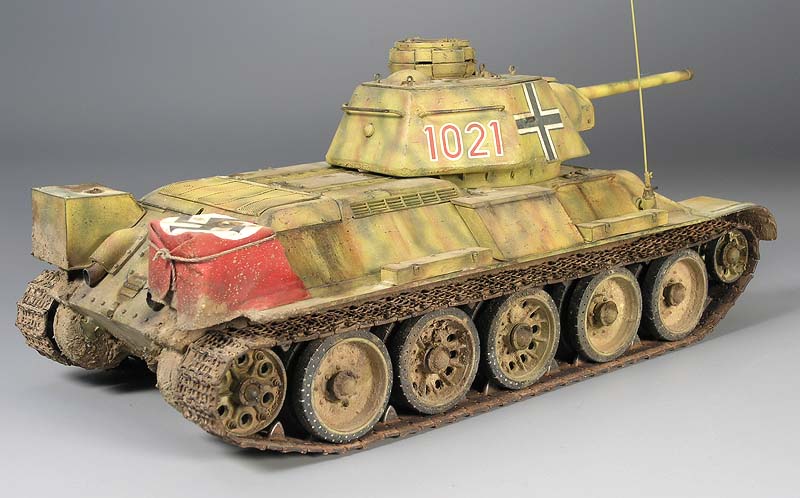
En las siguientes fotos se explica un método para simular barro seco y tierra apelmazada en ruedas utilizando pigmentos. Éstas son las ruedas (de un T-34) antes de ensuciar.
In the following images, a method to simulate dry mud and packed earth in tanks wheels by using pigments is described. These are a couple of T-34 wheels prior to start.


Se puede hacer de dos maneras ligeramente diferentes. Una es hacer una pasta con el pigmento y un medio para fijarlo y aplicarla en la rueda. El medio fijador es en este caso barniz mate diluido, aunque pueden usarse productos específicos como el fijador de pigmentos de Mig Productions o AK interactive, que funcionan igualmente pero está listo para sus uso directamente del bote.
This task can be done in two slightly different ways. One is to make a "paste" with the pigment and fixing medium and apply it on the wheel. The fixing medium can be matt varnish (like in this example) or ready to use fixing products such as Mig Productions' or AK interactive's.


Con esta pasta todavía húmeda se aplica más pigmento y una vez seco, más retoques puntuales. El truco es usar varios tonos aleatoriamente y utilizar un pincel más o menos fino, evitar la uniformidad y crear variedad.
When the paste is still wet, more pigments are added, and once dry, more fine retouches. The trick is to use several shades of pigments and to apply them with a fine brush avoiding monotony and creating tonal variations.


La otra forma es aplicar una generosa cantidad de varios tonos de pigmentos en seco....
The other way is to deposit a generous amount of several dry pigments...


...Y luego empaparlos, por capilaridad, con un fijador (disolvente, fijador de pigmentos...).
... And then soak them with a fixer (solvent, pigment fixer...)


De nuevo, se retocan con más pigmento seco.
Again, some more retouches with dry pigments.


Los efectos de grasa en los bujes se consiguen con una mezcla de óleo negro y barniz brillante más o menos diluido y en diferentes proporciones para conseguir diversos grados de intensidad. Hoy en día también existen en el mercado productos ya preparados para representar este tipo de suciedad. De nuevo se aplican con un pincel fino y por capilaridad.
Grease effects in the wheel hubs are made with a mixture of black oil paint and gloss varnish, more or less diluted and in diverse proportions to achieve different intensity results. Nowadays, there are several ready to use products to perform this task. Again, a fine brush is used.


Este es el resultado final.
Final result.

martes, 4 de septiembre de 2012

Viejas Glorias / Golden Oldies (II): A34 Cruiser Tank Comet (2007)


El concepto de cruiser tank surgió en los años treinta en el contexto de la doctrina británica del uso del arma acorazada. Los cruiser tanks debían ser rápidos y capaces de operar independientemente de la infantería, y su objetivo era penetrar en el frente enemigo, atacar su retaguardia y las líneas de aprovisionamiento, mientras que los infantry tanks tenían como misión acompañar a la infantería y por lo tanto el blindaje era más importante que la velocidad. La necesidad de velocidad en los cruisers tenía como consecuencia que debían ser poco pesados y por lo tanto ligeramente blindados y armados, y al principio, eran poco fiables desde el punto de vista mecánico y en consecuencia poco efectivos. Los problemas de movilidad fueron resueltos en su mayor parte en el A27M Cromwell, debido al uso del excelente motor Meteor, pero la cuestión de la escasez de blindaje y armamento permaneció. Para mejorar el diseño se tomaron dos vías. En una se partió de un Cromwell, cuyo chasis se ensanchó y se alargó con la adición de una rueda a cada lado y se le instaló una gran torre con el reputado cañón de 17 libras usado también en el Sherman Firefly. El vehículo resultante, bastante desgarbado, fue denominado Challenger y no fue muy exitoso debido a su altura excesiva y su blindaje todavía insuficiente; solo se produjeron 200 unidades. El otro proyecto evolucionó hacia una carro más elaborado, que aprovechó los puntos fuertes del Cromwell y mejoró sus puntos débiles, con una suspensión reforzada, una torre más espaciosa, más blindada y dotada de un motor eléctrico para el giro, y un nuevo cañón 77mm HV. Éste tenía el mismo calibre que el famoso 17 libras del Firefly (76.2 mm), pero de hecho era un arma diferente, que conservaba casi toda la efectividad del 17 libras pero con una munición más compacta, más fácil de estibar en un carro y que no era intercambiable con la del cañón del Firefly. Este nuevo carro, un especie de “primo de zumosol” del Cromwell, fue el A34 Comet.
De hecho, el Comet era un carro medio comparable a sus coetáneos Panther, T-34 o Pershing, y probablemente el primer diseño británico que estuvo a la par de los carros alemanes “modernos”. Las primeras unidades fueron construidas en septiembre de 1944 y enviadas a las unidades en diciembre de ese año. La 11 Armoured División iba a ser la primera equipada por completo con el nuevo carro, pero la ofensiva alemana en las Ardenas ocasionó que los carristas de esta unidad tuvieran que volver a toda prisa a sus Shermans y Cromwells. Una vez fracasada la ofensiva, la 11 AD se hizo cargo de sus nuevas monturas y continuaron el avance hacia Alemania en sus Comets.
El Comet no llegó a tiempo para participar en ninguna batalla a gran escala de la segunda guerra mundial, pero demostró ser un buen carro allá donde encontró oposición. Los acontecimientos más destacados en los que se vio involucrado fueron el cruce del Rin y el desfile de la victoria en Berlín en julio de 1945. Se fabricaron unos 1200 Comets hasta el final de la guerra.
El Comet participó también en la guerra de Corea y fue exportado a países como Finlandia, Sudáfrica, Irlanda o Birmania. Su sucesor fue el famoso A41 Centurion que estaba en parte basado en el Comet, y con el cual la denominación obsoleta cruiser se abandonó definitivamente. El Centurión fue el primer tanque universal o MBT (Main Battle Tank) británico.

En el año 2004, un nuevo nombre procedente de China hizo su aparición en la escena modelística internacional: Bronco. Esta compañía anunció una nueva serie de kits un tanto alejados de los caminos trillados que crearon grandes expectativas entre los aficionados. Sobre todo en sus comienzos, Bronco demostró una cierta predilección por los vehículos aliados de la segunda guerra mundial, especialmente británicos, lanzando al mercado maquetas tales como el Cruiser Tank A34 Comet, el Humber Mk I o el Staghound.
La opinión generalizada entre los expertos es que el Comet de Bronco (ref. CB-35010) es una buena maqueta. Por ello decidí que este fuera un proyecto divertido y relajante, sin pretender alcanzar una exactitud total. Simplemente un montaje “de caja” (con los “inevitables” correcciones y añadidos caseros) más orientado hacia el trabajo de pintura. Esas correcciones menores consistieron en la sustitución de las asas, moldeadas como “muñones” sólidos, con alambre, especialmente en la zona del cubremotor donde hay muchas de ellas. También en el añadido del cableado del faro de la torre, los soportes de las herramientas, el afinado de los guardabarros... También añadí textura en las paredes de fundición de la torre con masilla disuelta en pegamento líquido.

The concept of the cruiser tank emerged during the interwar period in the context of the British armoured warfare doctrine. Cruiser tanks had to be fast and operate independently from the infantry, piercing the enemy front and attacking the rear and supply lines, while infantry tanks were intended to keep pace with the infantry and thus protection was most important than speed. The need for speed in the cruisers leaded to a lesser attention to protection and firepower and the first cruisers were lightly armoured and armed, and even not too mechanically reliable, and thus not very effective. The mobility issues were mostly solved in the A27M Cromwell, due to its excellent Meteor engine, but the feeling of the need of a heavier and better-armed cruiser remained, and thus two paths were taken. In one of them, a Cromwell was lengthened, with an extra road wheel, and widened, a new big turret with the dreadful 17 pdr gun (the one used by the Firefly) was installed, and the not very attractive resultant vehicle was named A30 Challenger. It was too high and not too armoured, but the gun was a great improvement, and only 200 were produced. The other project evolved in a more elaborated tank, taking the strong points of the Cromwell and addressing its shortcomings with a reinforced suspension, a new, better-armoured electrically traversed turret, and a new 77mm HV gun. This has the same calibre as the 17 pdr, 76.2 mm, but it was in fact a different weapon, which conserved most of the effectiveness of the 17 pdr, with a more compact and easily stored ammunition that was not interchangeable with the Firefly gun one. This new tank, a sort of “Cromwell on steroids” was the A34 Comet.
The Comet was in fact a medium tank, comparable to its contemporary Panther, T-34 or Pershing, and probably was the first British design to be on pair with the “modern” German tanks. The first units were produced in September 1944 and delivered to the units in December 1944. In fact, the 11th Armoured Division was going to be the first one to be converted to Comets, but the German offensive at the Ardennes prompted the tankmen of this unit to quickly come back to their Shermans and Cromwells to stop the attack. Once the Germans failed, the 11 AD effectively took their new mounts and continued the war in the Comets.
The Comet did not arrived on time to participate in any major battles of WWII, but proved to be a good tank in the cases it found opposition. The major events in which it was present were the crossing of the Rhine and the victory parade in Berlin in July 1945. Until the end of the war, 1200 Comets were produced.
The Comet served in the Korean War, and was exported to countries such as Finland, South Africa, Ireland and Myanmar. Its successor was the famous A41 Centurion, which was partially based on the Comet, and in which the obsolete Cruiser denomination was definitely abandoned. The Centurion was the first British Universal Tank or Main Battle Tank.

In 2004, a new name from China entered in the plastic modelling scene: Bronco. This company announced a series of kits a little off from the paths usually beaten by bigger companies, which caused some expectation in the modelling community. Bronco demonstrated, specially at the beginning, a predilection for Allied, and specifically WWII British subjects, releasing among others vehicles such as the Cruiser Tank A34 Comet, Humber Mk I, Staghound or A13 Cruiser.
The general consensus among the experts in the matter is that the Bronco Comet (ref. CB-35010) is a good kit. Keeping this in mind I decided to develop this project as a fun and relaxing one, in which I will not seek for total accuracy, just an out of the box building (with the few “compulsory” amendments) and more oriented toward the paint work. These minor improvements were the replacement of the solid handles with metal wire, especially in the engine deck were there are plentiful of them, some wiring for the turret search light, some tool brackets, the sanding of the mudguards ends and grille covers to achieve a more scale appearance… I also textured the cast turret walls with putty dissolved in liquid cement.


lunes, 3 de septiembre de 2012

Figures

La parte modelística de las vacaciones ha consistido en pintar figuras... o más bien en intentarlo. Aparte de torpe soy muy lento, y más cuando estos fulanos llevan unas ropas tan "imaginativas". En fin, que terminar terminar, solo he terminado uno de los cinco que quizá vayan algún día en el "turno de noche". Por cierto, la figura es de Dragon con cabeza de Hornet

During the summer holidays I have been painting figures... or trying to do so. Not only this is not my strongpoint, but I am really slow, and more when these guys carry so "fancy" clothes. To cut the story short, I have only managed to finish one of the five figures that (maybe) the "night shift" dio includes. By the way, the figures is from Dragon with a Hornet head.


viernes, 10 de agosto de 2012

Última Publicación / Last article. AFV Modeller's "Modelling the Sherman Tank"

Ya tengo en mis manos el especial de la revista británica AFV Modeller sobre el Sherman, y debo decir que estoy muy impresionado. Es un magnífico libraco de 184 páginas, cargado de excelentes artículos modelísticos sobre el M4 en varias de sus versiones, con el añadido de una sección histórica con fotos de época. La calidad gráfica y el diseño es excepcional. Estoy muy contento de participar en esta obra con un artículo Titulado "Easy Eight riders" que muestra mi diorama con el Sherman M4A3E8(76) de Dragon y numerosas figuras (ver la imagen de cabecera de este blog).
No puedo dejar de recomendar este magnífico libro, disponible en tiendas del ramo y en http://shop.afvmodeller.com/.

I have just received the book "Modelling the Sherman Tank" from AFV Modeller, and I must say that I am really impressed. It is a thick volume (184 pages) full of superb articles on the ubiquitous American M4 Medium Tank, from el Alamein to Israel, plus an historical section loaded with war time images. The graphic design and the quality of the images are exceptional. I am really happy to participate in this work with my article “Easy Eight Riders”, depicting a diorama with a M4A3E8(76) and many figures (see the title image of this blog).
Highly recommended, available in modelling business and in http://shop.afvmodeller.com/.


viernes, 3 de agosto de 2012

Viejas Glorias/Golden Oldies (I): M24 Chaffee (2006/2007)


Llama la atención que los Estados Unidos, que emergió de la segunda guerra mundial como una de las dos superpotencias globales, empezara la contienda con una falta de preparación evidente en cuanto a carros de combate se refiere. Sus vehículos principales, el carro ligero M3 Stuart y el medio M3 Lee eran diseños anticuados, propios de los años treinta y poco adaptados a la guerra "moderna" que se anunciaba. El sucesor del Lee, el M4 Sherman fue una evolución de aquel, del que heredó alguna de sus características, pero que demostró ser muy versátil y capaz de aceptar modificaciones y mejoras constantes que le permitieron hacer frente a muchos de sus antagonistas a lo largo del conflicto. El Stuart recibió un lavado de cara en 1942, resultando el M5, pero su armamento y blindaje siguieron siendo insuficientes, y mantuvo el aspecto anticuado. Hasta 1944, no apareció un reemplazo adecuado para el Stuart en la forma del M24, llamado Chaffee en honor al general Adnam Chaffee, "padre" de las fuerzas acorazadas norteamericanas.
El Chaffee fue un diseño radicalmente distinto, muy alejado de su predecesor. Su aspecto moderno anunciaba el periodo de la guerra fría. Su arma principal era un cañón de 75 mm, un salto inmenso con respecto al cañón de 37 mm del Stuart. El cañón del Chaffee fue un desarrollo del cañón ligero montado en los bombarderos B25H Mitchell y su munición de alto explosivo poseía excelentes capacidades. Su blindaje estaba inclinado, sus cadenas eran más anchas y la torre lo suficientemente grande como para alojar a tres de los cinco miembros de la tripulación. La suspensión era del tipo de barras de torsión, un cambio radical con respecto a los diseños de carros anteriores en Estados Unidos. El aspecto del Chaffee era tan diferente al de los tanques anteriores del arsenal americano que creó cierta preocupación acerca de los posibles errores de identificación por parte de las tropas aliadas. Sobre todo, se pensaba que su aspecto podría llevar a confundirlo con el carro alemán Panther a cierta distancia o por tropas sin experiencia. De hecho, al principio se acuñó el sobrenombre de "cachorro de Panther" entre los soldados. Para familiarizar a la tropa con el nuevo vehículo, se organizaron giras de presentación del Chaffee en Francia en la segunda mitad de 1944.
Los primeros Chaffees se entregaron a los batallones de reconocimiento de caballería norteamericanos en noviembre de 1944, y tuvieron su bautismo de fuero en la batalla de las Ardenas. Fueron usados, de acuerdo con la doctrina acorazada americana para los carros ligeros, en papeles de exploración y apoyo de infantería mecanizada. El nuevo carro fue inmediatamente apreciado por sus tripulaciones, que agradecieron la gran mejora con respecto al Stuart, especialmente en cuanto al cañón. A pesar de que el Chaffee no estaba pensado para combatir a otros carros, su cañón de 75 mm daba a sus tripulantes la posibilidad de defenderse con ciertas garantías, y de hecho, un Tiger I y algunos Panthers cayeron ante el pequeño M24, eso si, en circunstancias muy favorables y con una buena dosis de fortuna. Sin embargo, el número de Chaffees enviados a Europa no fue muy grande y nunca reemplazaron por completo a los M5 Stuarts.
Los británicos recibieron un puñado de M24 en los últimos meses de la guerra. Asimismo, el M24 fue usado en la guerra de Corea (de hecho, fue el primer carro americano usado en la contienda debido a su presencia en la zona). En los Estados Unidos, el Chaffee fue reemplazado en la postguerra por el M41 Walker Bulldog, pero muchos M24 fueron transferidos en los cuarenta y cincuenta a países aliados como Francia, Italia, Bélgica, Dinamarca o Noruega bajo el programa de ayuda militar norteamericano. También fue exportado a otros países y fue utilizado en varios conflictos del periodo de la guerra fría, como Indochinca o la guerra Indopakistaní. En algunos ejércitos ha sufrido varios programas de modernización a lo largo del tiempo e incluso sigue activo en algunos países.
Hice esta maqueta en 2006/2007. Se trata de la "conversión" de Formations sobre la base del viejo (y obsoleto) kit de Italeri, con la adición de algunas piezas de Royal Model y cadenas de Friulmodel. Faltaban seis años para que apareciera la excelente maqueta de Bronco del M24 Chaffee...

It is noteworthy that the United States, one of the countries that emerged from WWII as one of the two global powers, entered the war with an evident lack of preparation in regard of tanks. Their main vehicles, the light M3 Stuart and the medium M3 Lee were dated designs, more typical of the thirties than of the “modern” warfare announced by the first tank battles of the conflict. The successor of the Lee, the M4 Sherman, was an evolution of the former that inherited some of its characteristics, but that was very versatile and was able to accept constant updates that kept it on pair with some of their antagonists. The Stuart received a revamp in 1942 becoming the M5, but still lacked firepower and kept its old fashioned look. This situation was evident and studies to find a replacement for the Stuart started giving eventually rise in 1944 to the M24 light tank, called “Chaffee” after the general Adnam Chaffee, considered as the “father” of the US armoured forces.
The Chaffee was a radically different design, very far from its predecessor. It has a modern look that announced the cold war era. Its main weapon was a 75 mm gun, a quantum leap from the 37 mm gun mounted by the Stuart. The Chaffee gun was a development from the gun mounted in the B25H Mitchell bomber and has excellent high explosive capabilities. The armour was slopped, the tracks wider and the turret big enough to accommodate three members of the crew of five. The suspension was of the torsion bar type, a depart from the usual practise in the US tanks design. The look of the Chaffee was so different from the previous tanks in the American arsenal that it was some concern about possible mistakes in its identification by allied troops that could lead to some fatal results. Especially, its new torsion bar system and slopped armour could lead to confuse the Chaffee with the German Panther when seen from away or by inexperienced soldiers, and in fact the term “panther pup” arose sometimes. In order to familiarise the troops with the new tank, a “presentation” tour was held in France in the second half of 1944.
The first Chaffee’s were delivered to the US Cavalry Reconnaissance Battalions in Europe in November 1944 and made their debut in the Battle of the Bulge. They were used, in accordance with the US armoured doctrines for light tanks, in scouting roles and as support for the mechanized infantry. The new tank was liked by its crews, who appreciated the improvement with respect of the Stuart, especially on the gun. Despite the Chaffee part was not the tank-vs-tank combat, the 75 gun gave to the crews the opportunity to fight back if necessary, and in fact, a Tiger I and some Panthers were prey of the small M24, always in favourable circumstances and with great deal of luck for the Americans. Nevertheless, the numbers of Chaffees sent to Europe was not very big and never replaced completely the M5 Stuart.
A bunch of M24 was delivered to the British in the last stages of the war. Also, it was used in the Korean war (in fact, it was the first US vehicle available there). In the US, the Chaffee were superseded by the M41 “Walker Buldog”, but many M24 were transferred in the forties and fifties, under the Military Assistance Program, to western armies, such as France, Italy, Belgium, Denmark, Norway… It was also exported to many other countries, and was used in several cold war era conflicts, such as Indochina or the Indian-Pakistani wars. It received several modernisations in some armies, and it even still is on the active list in some countries.
I made this model in 2006/2007 and it is based in the Formations conversion for the old Italeri kit. Some bits from Royal Model and Friul tracks were also used. That was six years before the gorgeous Bronco kit hit the market....